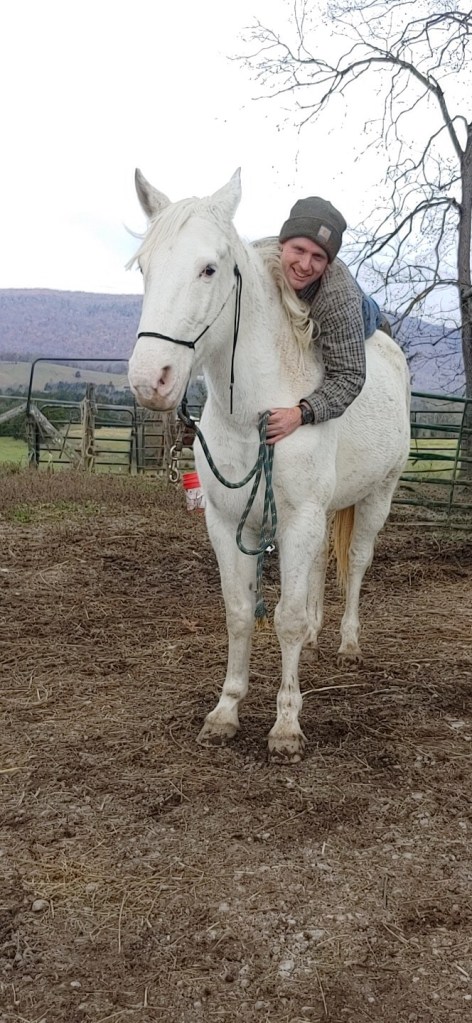
Beginning your horsemanship journey.
This article will be for people who have horses or have access to horses. I know some don’t, but I hope that if you’re interested in horses that you are working toward the goal of being able to interact with horses on a regular basis.
I learned this technique from Warwick Schiller. He has a YouTube channel, and an online membership group, as well as “in person” clinics where he works with many people and their horses. My understanding is that he has a background in the reining world.
What I like about Warwick Schiller is
his humility and his willingness to change his horsemanship as he learns more. The videos he puts out today are different from the videos he put out say five or six years ago. This puts him in agreement with the vision here at Apprentice of the Horse. We are constantly learning. That’s why the tagline here at Apprentice of the Horse is about the journey of horsemanship.
This exercise is perfect for beginners just starting out learning about equine communication. It is also helpful for hot, nervous horses or for the horse that is hard to catch in the pasture.
To begin the exercise that we will be talking about today, all that is needed is you and your horse. You could optimize this technique by having a stick with a flag on it or a lead rope, but these will just be extensions of your arms and hands and are not required.
This technique can be done in a stall, in a pasture, even in a horse trailer. And, it will be a process that, once learned, can and will be used daily in your interactions with horses.
I recommend doing this from the first interaction of the day with your horse. In other words, don’t go get your horse take it to the round pin, then begin this activity. Practice this the moment you are within eyesight of your horse.
This technique will take being attentive to the horses expression, including all of its body parts from nose to tail.
As you get within eyesight of your horse, approach until he acknowledges you are there. Sometimes this will be a raise of the head. Sometimes this will be a flick of the ear toward you. Sometimes this will be a turning of the head to put you in its vision. Approach until the horse notices you. If he doesn’t right away maybe flick the stick and flag or lead to get his attention. When he does acknowledge you, stop and maybe step back two steps. What you are wanting is for the horse to just notice you, and to notice that you noticed him noticing you.
You want him to realize that you are listening to him.
The horse will eventually begin to continue whatever it was he was doing when you approached him.
When he puts his head back down to muzzle the hay or puts his head back in the corner of his stall or whatever it was that he was doing before, begin to approach again. Likely, you will get a couple of steps past your first stopping point. And again, when he acknowledges you, stop. Maybe take a step back. Wait, then repeat.
This whole process may take 2 minutes or 30 minutes. But it will be well worth it in the end. This process will be repeated until the horse either walks up to you, or stands with his head low and relaxed while you walk up to him.
If you do this whole process without rushing your first step in equine communication has begun.
You could stop there for the day. Or, you could continue. But, either way you have made a huge impact in your relationship with the horse.
 Apprentice of the Horse